If you have searched "what is an OnlyFans agency?" online, you’re probably getting recruiting DMs, seeing agency ads on Instagram, or hearing that you'd grow faster with management. It can look appealing, especially if you’re doing everything alone.
Here's the straight answer: OnlyFans agencies are companies or teams that assist with your marketing, DMs, pricing, posting, and management. The range includes very helpful agencies, overpriced ones, and some that are honestly quite risky. In a crowded market where average creator earnings are still modest, it makes sense that more creators start looking for help.
Here’s what this article will help you understand:
- what an OnlyFans agency usually does
- when OnlyFans management can help and when it may not
- how an OnlyFans agency contract usually works
- how to read OnlyFans agency reviews, agency lists, and Instagram DMs more carefully
- what to try if you want support without giving away a huge cut
The goal is not to push you into or away from agencies. It’s to help you make a smarter decision before you hand over money, access, or control. It also helps you judge whether agency support makes sense now, later, or not at all for your current stage of growth.
What an OnlyFans agency usually does
This section explains the basic model in plain English. It helps because a lot of creators hear the word “agency” before they ever see what the work actually includes.
Agencies usually sell time, structure, and labor
Most OnlyFans agencies package a mix of services such as subscriber DMs, promotion, content planning, pricing support, and day-to-day account management. Some are full-service, while others focus more narrowly on chat operations or traffic.
A site like Phoenix Creators presents the agency model as hands-on support with work such as chatting, captions, ads, and strategy. By contrast, software-focused products usually emphasize dashboards, analytics, and workflow support rather than taking over execution.
In simple terms, agencies mainly sell labor and execution, while tools mainly sell systems that you still manage yourself.
Hiring an agency doesn't remove your business risks
This is the part many beginner creators miss. Even if a team is helping you, your name, content, reputation, and payout risk can still sit with you. If an agency handles your page badly, the brand damage usually hits the creator first, not the agency. Legal commentary on management agreements keeps coming back to the same warning: some contracts reduce creator control more than people expect.
Agencies typically take a percentage of your earnings
A common structure is a percentage of earnings instead of a flat monthly fee. In practice, public agency and legal sources often point to broad ranges like 30% to 50%, depending on how much work the agency takes over. If the split is high, the service should be high too. Source: https://www.phoenix-creators.com/onlyfans-agency-guide, https://venustaslaw.com/blogs/blog/onlyfans-creators-beware-five-contract-traps-that-could-ruin-your-career
Who should use an OnlyFans agency and who should not
This section helps you judge fit, not hype. That matters because an agency can help the right creator, but it can also take a painful cut from someone who is still learning the basics.
Before committing to an agency, it's worth checking whether the right management tools might solve the same problem for less — this guide to OnlyFans management tools covers what software can handle versus what still requires human oversight.
You may be a good fit for an agency if you are growing but overwhelmed
An agency can make more sense when you already have proof of demand. Maybe you get steady traffic, your DMs are overwhelming, or you know your content sells but you cannot keep up with the workload. In that case, management may help you protect time and raise average revenue per fan instead of just working more hours.
You may not be a good fit yet if you are still figuring out your brand
For new creators, OnlyFans agencies can be premature. The biggest risk is handing over a significant percentage of your income before you've figured out your own direction. If you still do not know your pricing, posting rhythm, or audience, you may not need an agency yet. You may just need a tighter workflow and a clearer offer.
A middle-ground approach may be safer than outsourcing completely
A lot of creators do not need “an agency.” They need one specific fix. That might be help with captions, a part-time editor, better planning, or support with DMs during busy hours. Paying for one bottleneck can be safer than handing over half your revenue.
How an OnlyFans agency contract usually works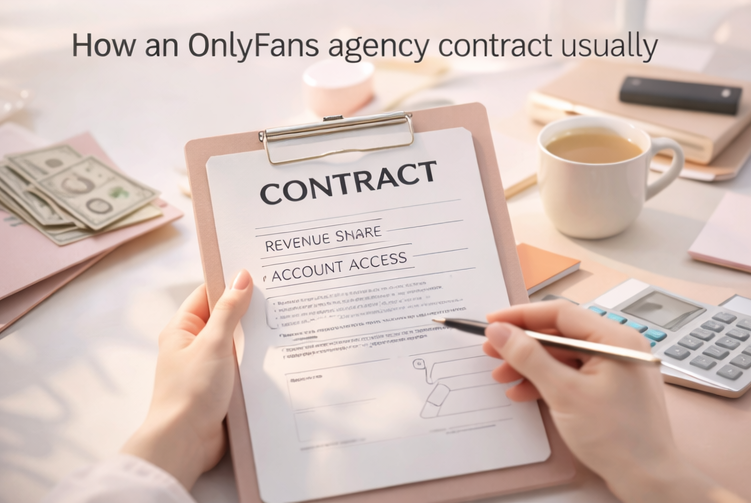
This section covers the part that matters most once the sales pitch starts: the contract. It helps because vague promises are easy to sell, but contracts decide who controls your money, content, and exit.
If you're considering hiring a chatter rather than a full agency, this complete guide to hiring an OnlyFans chatter walks through the cost differences, vetting process, and contract terms that protect you either way.
Revenue share should match the value delivered
A higher cut only makes sense if the agency is clearly doing high-value work. That can include staffing DMs, handling traffic, building offers, and reporting performance every week. If a team wants 40% or 50% but cannot explain what they do line by line, that is a problem. Legal sources specifically warn creators about unfair revenue splits and hidden fees.
You should keep control of payouts, accounts, and content ownership
This is one of the biggest contract issues. Venustas Law warns that some agreements try to transfer control of the creator’s account, branding, or content. A safer setup usually keeps the creator as the owner, with the agency getting limited access for support work.
The exit terms matter more than the sales pitch
This is not legal advice. OnlyFans policies are subject to change. Always check the latest Terms of Service. Before signing, look for auto-renewals, long lock-ins, termination penalties, and unclear handoff language. If you cannot leave cleanly, the “growth” offer can get expensive fast.
How to spot red flags in agency reviews, lists, and Instagram DMs
This section is about pattern recognition. It helps because bad agencies rarely introduce themselves as bad agencies. They usually show up as polished DMs, flashy promises, and vague case studies.
Red flag 1: Promising big results with no proof
Be careful with promises like “we’ll 10x your income” or “we guarantee growth.” Even agency marketing pages that sound polished are still sales pages. You want proof, not just screenshots and energy.
Red flag 2: They want full access before trust is established
If an OnlyFans agency scout on Instagram wants your passwords, payout control, or account ownership too early, slow down. Good support can exist without giving away everything on day one.
Red flag 3: reviews and listings are not necessarily neutral
Some OnlyFans agency listings are more like directories or lead-generation pages than actual evaluations. And some OnlyFans agency reviews are written by affiliates, competitors, or the agencies themselves. That does not mean every review is fake. It means you should compare several sources and look for repeated complaints about access, fees, ghosting, or poor chat quality.
Alternatives to full-service OnlyFans management
This section gives you lower-risk options. That matters because “agency or nothing” is not your only choice, especially if your biggest pain point is just one part of the job.
Hire a specialist instead of a full agency
If you mainly need editing, planning, or admin help, it can be cheaper to hire one freelancer instead of signing a large rev-share deal. That gives you more control and makes it easier to swap support if something is not working.
Use software before hiring a manager
Some creators get better results by improving systems first. Scheduling tools, analytics, and safer workflow software can reduce chaos without giving another company control over your whole business. Source: https://onlymonster.ai/, https://creatorflow.so/blog/best-automation-tools-onlyfans-creators
Try a human-led support model if DMs are the real problem
A lot of creators do not actually need a full agency. They need help getting out of the daily DM grind without giving up control of their business. If that sounds familiar, FanPort is one lower-risk option to consider. It is built as a human-led, AI-assisted support tool that helps reduce repetitive messaging work while keeping the creator in control of the relationship with each fan. AI can help with drafts, suggestions, and workflow, but it is not meant to replace the creator or run the account as a fully automated bot. For paid subscribers and VIP fans especially, the creator still reviews and handles important conversations personally. That makes it easier to stay responsive, protect trust, and build stronger fan relationships without handing your entire page to an outside agency. For creators who want to earn more through stronger engagement, not just more followers, this kind of support can be a practical middle ground. Want to grow faster with this service? Click here.
FAQ
What is an OnlyFans agency?
An OnlyFans agency is a company or team that helps creators with growth, DMs, pricing, promotion, and account operations.
Are OnlyFans agencies worth it for beginners?
Sometimes, but often not right away. Many beginners do better by learning their own offer first.
How much do OnlyFans agencies charge?
A common range is a revenue split, often around 30% to 50%, but it depends on the services included.
What should be in an OnlyFans agency contract?
Clear fees, ownership terms, payout rules, access permissions, renewal terms, and exit terms.
Are OnlyFans agency jobs legit?
Some are legitimate, but some turn out to be low-paid sales or chat roles with vague expectations. Read the job terms carefully before applying.
Should I trust an agency just because it has Instagram scouts or a big agencies list page?
No. Use those as starting points, not proof.
Can I grow without an agency?
Yes. Some creators do better with targeted freelancers, better systems, or human-led AI assistance instead of full outsourcing.